
We are not telling you to reach out to recruiters on LinkedIn and apply to 50 jobs a day. Like, no, this is a new job market we are in. 2026 is the beginning of a whole new era. And so we’ll give you advice that is actually going to work for 2026, the modern day workplace for the modern day worker.
The thing about this guide is that it’s not just based off of vibes and theorizing what we think might work. No, it’s based off of cold, hard data and lots and lots and lots of case studies. It’s almost like we know what we are talking about and this advice works.
All right, let’s get into the business of the day.
Table of Contents
What This Guide Covers
Here’s a little breakdown of what we’re going to be covering in this guide. First, we are going to explain to you the two reasons why it feels so difficult to get a new job right now. And no, you’re not crazy or lazy. It’s just different now.
Number two, we are going to reveal to you job search strategy that whenever people gets to know about it, they always have much more luck landing job interviews. And finally, number three, we are going to do a rapid fire round of advice. Just quick little things here and there that you can change or implement to improve your job search and start getting interviews at some of your dream companies.
Let’s get into it.
The Old Way of Hiring Is Dead
You’re not lazy, but old way of hiring is dead. The linear career path, in hospice. Climbing the corporate ladder is on life support. And that’s both good and bad. The reason that people are struggling comes down to two different things.
Number one, something that you can’t control, which is the economy and job market. And number two, something that you can control, which is your strategy. We are going to focus on the second thing, what you can control, and that is your strategy, your behaviors, your actions, your choices, and what you choose to do.
Why is Hard to Find a Job
But first let us just explain what’s going on with the economy. So according to Indeed’s 2026 jobs report, we are in what’s called a low fire, low hire environment. It basically means that we are in a very, very, very stale job market. There’s just not a lot going on. Not a lot of people are hiring. Not a lot of people are firing. People are kind of just staying put, doing what they’re doing.
The State of the Economy
Job postings have declined nearly 10% year over year. And the sectors that are getting hit the hardest are professional services, consulting, and tech. Of course, the federal government had a big hit last year. Meanwhile, industries like healthcare, construction, and the skilled trades can’t find enough workers. There’s massive, massive demand.
So that’s why a lot of people feel gaslit is because some industries are super hot and they can’t find enough workers, and you can get a job like so quickly. And then other industries are really hurting. They’re being impacted by policy and AI and innovation and perceived innovation. That was the economy.
The Broken Online Hiring Process
But now let’s look at the second reason why it’s so hard to find a job. The utterly broken online hiring process, the whole thing, soup to nuts. It is non-functioning. According to a 2025 greenhouse study, 18 to 20, 22% of all jobs are ghost jobs. Positions that either don’t exist or the companies have no urgent need of filling. And before you’re like, ghost jobs should be illegal. They are illegal. It is illegal to post a ghost job.
However, you and me could both go online right now and post a job that we have no intention of filling. And there’s no way that job platform, LinkedIn, Indeed, ZipRecruiter could know that it’s a ghost job. Because if they contacted us, we would just say, “Oh no, that job’s legit. We’re really looking to hire.” Like there’s no way to gauge intention. And it really, really sucks.
Besides ghost jobs, the way we hire now is basically taking friction out of the entire process. Back in the day, you used to have to like find a job ad in the newspaper, literally type out your resume, drive down to the company and like hand your physical paper resume to a receptionist. There was so much friction to apply to one job.
But nowadays there’s like AI auto-apply bot things that’ll apply to a thousand jobs within one second for you. And so that means that the systems companies used to hire are getting clogged. If you want to get a job this year, this is what we recommend that you do.
The Strategy That Actually Works: Company Forward Approach
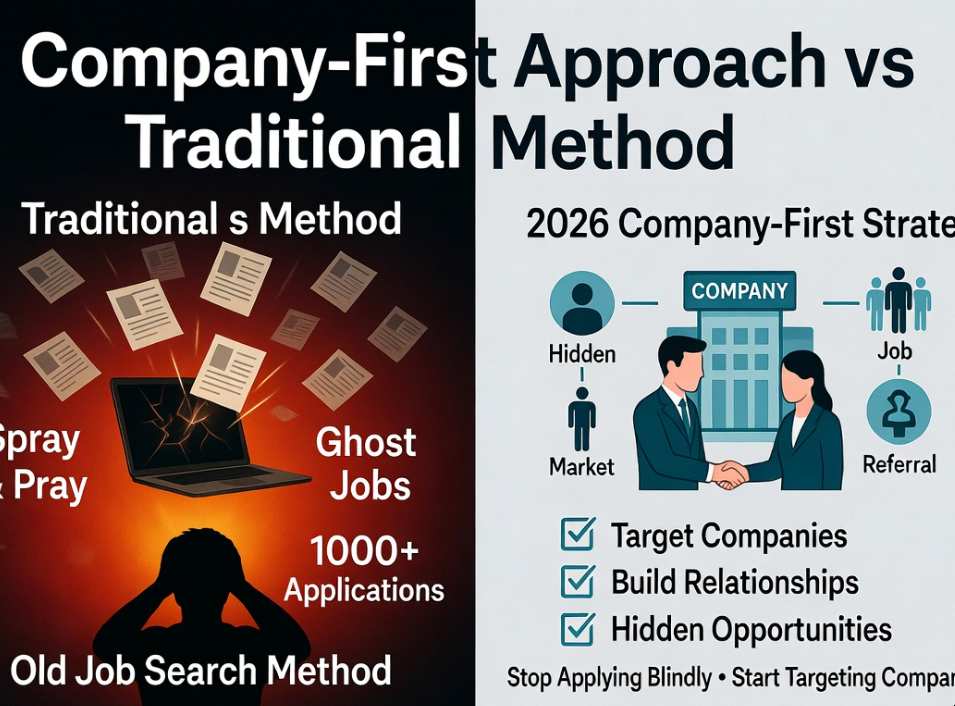
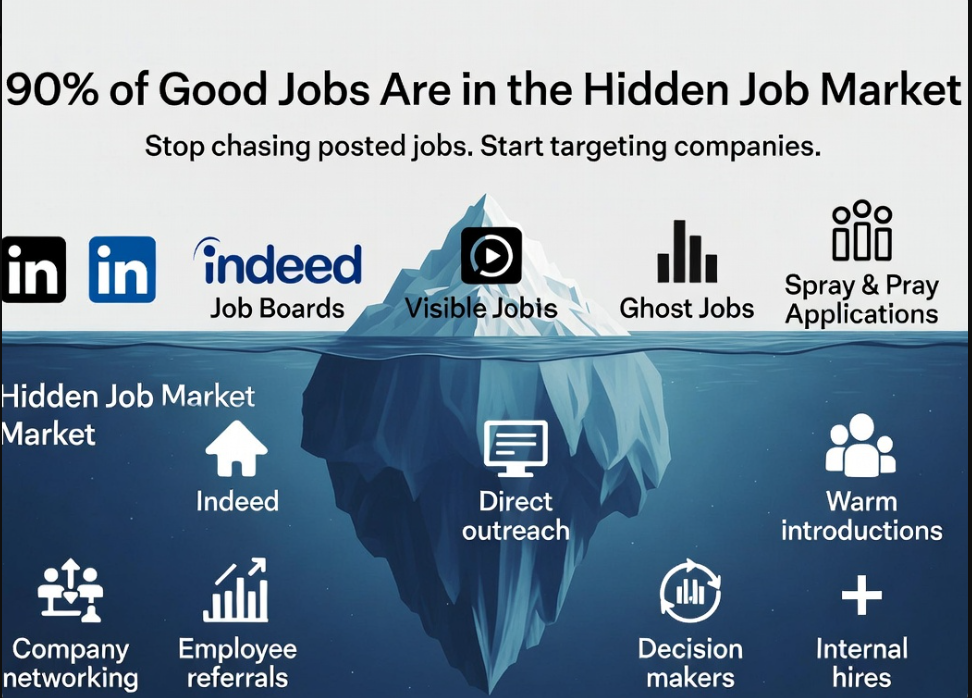
You need to switch from a job forward approach to a company forward approach. What does this mean? A job forward approach is what most people do. They go on Google, they go on Indeed, they go on LinkedIn and they search for jobs. They search for open roles that have been posted to the internet that are available to everybody, the public, the visible job market. This is one way to get a job and it’s what 99.99% of people do.
Tap Into the Hidden Job Market
However, it is recommended that you take a company forward approach. This is where instead of pursuing jobs, you pursue companies. And this is because more often than not, companies don’t hire a random person off the internet. They hire somebody who has referrals, who knows somebody who works there, who has a good recommendation. They hire through word of mouth. This is also known as the hidden job market. So while they’ll post the job online, they’re really just hiring somebody who knows someone. And that’s not a bad thing.
If you’re running a company, you would rather hire somebody who has a real person to recommend them than a random person online. There’s just more trust there. This is like tribalism. It goes back to like our oldest caveman brains. However, with the online job hiring process being so broken, this is happening so often.
Who Actually Makes Hiring Decisions
Remember, computers don’t hire, okay? They might help with scanning resumes or cover letters and stuff like that, but at the end of the day, they actually don’t hire. And recruiters don’t even hire. HR doesn’t even hire. They curate and compile and filter and interview. But at the end of the day, it’s usually the department head who actually makes the final hiring decision.
So it’s important that you don’t just network with recruiters or something. You also go network with the actual decision makers at the end of the day. A company forward approach. So what we need you to do is you can still go on the hiring platforms and just research companies. Just make a list of like 10 to 20 companies that you would like to work for.
How to Execute the Company Forward Approach
You’ve looked at their website, you like their mission thing, you like their benefits, they have some jobs posted, maybe not the exact job you want, but you know that job exists at that company. And then you wanna put them in an Excel spreadsheet, Notion, Airtable, whatever you use. And then all you gotta do is just stalk that company. Easy as that. Follow them on social media, put out a little job alerts thing on LinkedIn and just kind of keep tabs on them.
Maybe on LinkedIn, you can go to the little people button. You can see who works there. You can see if anybody from your university works there. You can start to kind of reach out and say, “Hey, I just want to introduce myself. I know you don’t have any open positions right now, but I’m interested in being considered. You know, in the future, if you do, here’s my resume, you can keep it on file.” You just kind of have this soft approach to it. I’m interested in pursuing a career in this company at some point. No pressure right now. I’m just kind of poking around, seeing what’s out there. And then that way, when you do end up applying to that open world that opens up, you already have an established relationship. You already have those connections. And this is how people are getting the good jobs.
The jobs that have great bosses, that pay well, that have good hours. Random people are not getting those incredible hybrid or remote jobs that pay well, that have great, like those are going to people who have the ability to network. The reason that this works so well is because 99% of people don’t do it and they’re not willing to do it. A lot of you reading this right now are like, “Nah, I’m gonna stick with my spray and pray,” they call it. That’s what they call it in HR, spray and pray.
It’s when you just apply to a bunch of jobs and you just, you know, pray that some spaghetti sticks to the wall. And that’s fine. Like that is your prerogative. We are not forcing you to do anything. And that’s why this works for the 1% of people who do it is because most people aren’t doing it.
Job Search Tips That Work
1. Always Be Networking (ABN)
Number one, ABN, always be networking. Networking doesn’t mean that you’re in some stuffy conference room with name tags. The best networking ever is when you’re at like your cousin’s wedding and you meet their friend who happens to work in the same industry as you. Like that, that is the most authentic, best networking you can possibly do. It’s just making professional friends. It’s not scary if you know how to do it right. Being a normal human, talking to other humans, asking people what they’re up to, what you can do for them, you know, sending them articles they find interesting, checking in, liking their LinkedIn posts, like, it’s just networking.
Always be networking. Always be making positive impressions on new people. You just wanna keep spreading that web and making it as wide as possible.
2. Keep Your Resume Warm
Number two, keep your resume warm. Keep it toasty. The job search used to take around three to six months on average, but now it’s taken more like seven months on average. And that’s just the average. Long-term unemployment has really spiked or new grad unemployment has really spiked. So for some demographics, it’s taken them even years to get a new job. So even if you have a job right now, if you’re in an industry where like layoffs are happening or like policy might affect your industry, keep that resume warm.
Dust it off a little, take a little look at it. For certain, it’s annoying to never feel settled. You gotta keep that resume warm. Just keep it nice and toasty.
3. Consider Pivoting
Number three, consider pivoting. Sometimes when you’re really struggling in your job search, you’re actually searching for a role that is actually declining. So companies aren’t really desiring that exact role anymore. And maybe like AI is changing it or your industry is just kind of like morphing and shifting into this new thing. So if you can like slightly tweak or like make a lateral move to another industry doing the same thing, or maybe just blow everything up and make a giant pivot. If you have the money saved up and you have a plan and a safety net and you want to go start your own business or like completely do something else, that’s not a bad idea.
4. Put AI on Your Resume
Number four, and this one really works y’all, you gotta put AI on your resume. And on your LinkedIn profile. Now, of course, please use common sense. If your industry is not so keen on AI, maybe you work in creative stuff or maybe you’re in publishing or something like that, don’t do this part.
However, most industries are fairly keen on AI. And so by just implying that you’re AI curious, or AI literate, or you’re willing to lean into AI on your resume can take you very far. There are several companies just completely scrapping resumes that don’t mention AI. It’s not so much they want you to have AI skills, but they want to hire people who are willing to embrace it. And if you’re reading this and you’re like, “nope, I’m not doing anything AI,” then don’t do it. But just adding things like ChatGPT or Clod or Perplexity, or if you really wanna play it safe, 99% of Fortune 500 companies use Microsoft Copilot.
So sticking Copilot on there is actually really safe. People trust Microsoft. But it is recommended just, you know, putting it on there, just kind of covering that base, see what happens.
5. Check All the Boxes
Finally, just make sure all your boxes are checked. You got a nice clean ATS optimized resume. Make sure that you have that LinkedIn profile set up. You got a nice professional photo. You got a nice headline. You got a little summary, some experience, maybe some recommendations. And you have a nice clean digital footprint. If they Google your name, you know what comes up, which they will. By the way, Google your name and they will look you up on social media.
If you’re like, “Oh, my name isn’t attached to my handle,” they have ways around that. So definitely make sure you’re nice and buttoned up.
Conclusion
2026 is a skills-focused market. Skills are now the number one thing companies look for. In general, they’re more important than degrees, years of experience, places you’ve worked. Companies really don’t care about what you’ve done. They care about what you can do. So don’t rest on your laurels. Instead, talk about what you wanna do and where you wanna go.
This is a great thing because if you’re motivated and willing to grow and learn, then there is a company out there that would be lucky to have you. And remember y’all, when you’re looking for a new job, it can be taxing. So take breaks, give yourself some grace. A lot of people are really struggling right now, so it’s not just you.
Remember, respond to those rejection emails. No, really, responding to rejection emails is like one of the favorite pastimes because it’s just so bold, it’s so confident. Remember, you got this.