
Skha Graduate Development Program (SGDP) Batch 3 is a 12-month structured program for proactive, responsible, and skilled individuals seeking to start a career in management consulting, and if you are a fresh graduate wondering where your academic excellence actually takes you in the real world, this program might be the most important opportunity you read about this year.
Let us be honest about something that most university career offices will not tell you directly. Getting a degree is one thing. Knowing what to do with it on day one of a professional career is something else entirely. The gap between academic achievement and professional competence is real, it is wide, and it catches a lot of talented graduates completely off guard. Management consulting, in particular, has a reputation for demanding a level of structured thinking, client communication, and problem-solving agility that no semester of coursework fully prepares you for.
That is precisely the gap SGDP is designed to close.
This guide covers everything you need to know about Skha Graduate Development Program Batch 3, from what the program actually is and why it matters, to the specific eligibility requirements, the application process, the recruitment stages, and what your career could realistically look like if you make it through. Whether you are actively preparing your application right now or simply exploring whether management consulting is the right path, read this from start to finish. The information here could meaningfully shape the next chapter of your professional life.
What Is the Skha Graduate Development Program?
Skha Graduate Development Program (SGDP) returns for its third batch as a structured 12-month development program designed for proactive, responsible, and skilled individuals who aspire to build a career in management consulting. As an Associate Trainee, you will have the opportunity to grow and transform into a full-time Consultant at Skha.
That sentence is worth sitting with for a moment, because it captures something that genuinely distinguishes SGDP from most graduate schemes you will encounter in Indonesia’s professional landscape.
Most corporate training programs work like this: a company hires you, puts you through a few weeks of onboarding, and then expects you to figure the rest out on the job. Some organizations call this “learning by doing,” and while there is real value in that approach, it can also feel like being thrown into a swimming pool and told that drowning is how most people learn to swim.
SGDP takes a fundamentally different philosophy. It treats the development of a consultant as a craft that requires structured investment, deliberate practice, expert mentorship, and progressive exposure to real challenges. The 12-month timeline is not arbitrary. It reflects a genuine understanding of how long it actually takes to build the foundational competencies of a capable management consultant: the analytical rigor, the communication clarity, the client management instincts, and the professional judgment that experienced consultants develop over years but that can be meaningfully accelerated through the right structured environment.
Skha itself is a management consulting firm that works across strategic and operational challenges for clients across sectors. The firm’s approach to developing its people is embedded in how it thinks about value creation for clients: both require clarity of thinking, quality of execution, and continuous improvement. The SGDP is not a side project or a talent pipeline afterthought. It is a deliberate investment in building the next generation of consultants who will carry Skha’s work forward.
The fact that this is Batch 3 matters. The program has history now. The first two batches produced Associate Trainees who went through the development journey and came out the other side as consultants. Skha has learned from those cohorts, refined the program structure, strengthened the mentorship mechanisms, and arrived at Batch 3 with institutional knowledge about what the development journey actually looks like from both sides. That is not a small thing. You are not a guinea pig in an experiment. You are entering a program that has been tested, iterated, and improved.
Why Join Skha
Before we go any deeper into the logistics of SGDP Batch 3, it is worth stepping back and asking a more fundamental question: why Skha, and why management consulting at all?
These are questions you should be asking seriously rather than treating as rhetorical. The answer shapes everything from how you frame your application to how you sustain your motivation through the demanding 12 months of the program itself.
The case for management consulting as a career starting point
Management consulting is frequently cited as one of the highest-value starting points for a professional career, and not simply because of the financial rewards, although those tend to be competitive. The more meaningful reason is what consulting does to your thinking.
When you work as a consultant, you are constantly asked to enter unfamiliar situations, understand them quickly, identify the core problems beneath the surface, and develop structured recommendations that a client can actually act on. You do this across different industries, different organizational cultures, and different types of challenges. The breadth of exposure, combined with the demand for rigorous thinking and clear communication, creates a professional development environment that is genuinely hard to replicate in a specialized functional role within a single organization.
Graduates who start their careers in management consulting frequently report that the skills they developed during those early consulting years, structured problem decomposition, hypothesis-driven thinking, stakeholder communication, data interpretation under uncertainty, became foundational capabilities that served them regardless of where their careers subsequently went. Some stayed in consulting and built deep expertise there. Others moved into industry, government, entrepreneurship, or development sector roles, and brought with them a consulting mindset that made them more effective in every context.
Why Skha specifically
There are consulting firms and then there are consulting firms. Size, culture, the nature of client work, the quality of internal development, the degree to which senior consultants are genuinely invested in developing junior talent, these factors vary enormously across organizations that all technically carry the “consulting” label.
Skha’s identity as a firm is built around authentic problem-solving and meaningful client impact. The work is substantive, the team is professionally serious, and the culture values intellectual rigor without the kind of toxic performance pressure that characterizes some high-profile consulting environments. For a graduate entering the profession, that combination matters enormously.
The SGDP is evidence of Skha’s investment in people development. Organizations that do not genuinely value their junior talent do not build structured 12-month development programs with experienced consultant mentorship and real project exposure. They hire people and extract output until those people burn out or leave. The existence and continuous refinement of SGDP signals something specific about how Skha thinks about the people who work there.
The Batch 3 cohort advantage
There is something particular about being part of a cohort, a group of peers who start the same journey at the same time, face the same challenges, and progress together. The SGDP cohort model creates a peer learning dynamic that multiplies the formal program investment. Your cohort members become your first professional network, your thinking partners on difficult problems, your mutual accountability system, and, frequently, your long-term professional relationships.
In management consulting, where relationships and trust are currency, starting your career with a cohort of equally serious, equally motivated peers is a structural advantage that compounds over time.
Graduate Development Program Batch 3
SGDP Batch 3 is the most refined version of the program to date, and understanding its full shape helps you assess whether it genuinely fits your ambitions and your current readiness.
The program runs for 12 months. That is a meaningful commitment, and it is worth being honest with yourself about what that means before you apply. Twelve months of structured development work alongside real consulting projects requires genuine dedication, the ability to manage your time and energy across multiple demands simultaneously, and a fundamental orientation toward growth rather than comfort.
The program is structured around four interlocking pillars that together create the development environment Skha is investing in:
Real consulting project experience. Associate Trainees at Skha are not placed in a back-office training room while senior consultants do the actual work. You engage with real projects for real clients from early in your tenure. This is the element of SGDP that differentiates it most sharply from academic or purely theoretical training programs. The exposure is genuine, the stakes are real, and the learning that comes from navigating actual client challenges is qualitatively different from any case study or simulation.
Comprehensive professional training across key business and consulting skills. The structured training component of SGDP covers the technical and professional disciplines that practicing management consultants use every day. This includes analytical frameworks and problem-solving methodologies, data analysis and financial modeling, business writing and presentation design, client communication and facilitation, project management fundamentals, and the industry and functional knowledge that provides context for consulting engagements. The breadth of this training is designed to give Associate Trainees a foundation that is both immediately applicable and durable over the long arc of a consulting career.
Coaching and mentorship from experienced consultants. Every Associate Trainee in SGDP is connected to experienced Skha consultants who provide regular coaching and mentorship throughout the program. This is not a formality. The coaching relationship is a core mechanism through which professional development actually happens. Having someone more experienced who has navigated similar challenges, who can give you honest feedback on your work and your professional behavior, who can help you interpret confusing situations and make better decisions, is one of the most valuable forms of professional development that exists. It is also one of the rarest in early-career programs that claim to offer mentorship but deliver only occasional conversations with busy senior people who have no real investment in the mentee’s development. Skha’s mentorship model is substantive by design.
A clear pathway to a full-time consultant role. The program culminates in a genuine opportunity to transition to a full-time consultant position at Skha. This is not guaranteed based on completion of the program; it is earned through demonstrated performance, growth, and professional contribution during the 12 months. But it is a real pathway with clear criteria, not a vague promise. Associate Trainees who perform well and demonstrate the competencies and character that Skha looks for in its consultants have a genuine opportunity to stay and build their career there.
What SGDP Offers to Associate Trainees
Every program description lists its benefits. What is more useful is understanding what those benefits actually mean in practice, day to day, across 12 months of real work.
What comprehensive professional training actually looks like
Imagine sitting in a room on your third day at Skha and being asked to structure a 10-minute presentation on a business problem you have never encountered before, for an audience of senior consultants who will ask sharp follow-up questions. That scenario is not comfortable. It is also one of the fastest ways to develop the structured thinking and confident communication skills that consulting demands.
SGDP’s training is not primarily about absorbing knowledge passively. It is about being stretched in structured environments where you learn by doing, get immediate feedback, reflect on what worked and what did not, and improve. The training design is built around the learning methodologies that actually accelerate professional competence: deliberate practice, spaced repetition, application in real contexts, and feedback from more experienced practitioners.
The business and consulting skills covered in the training span both hard and soft dimensions. On the harder side, you will build analytical skills including structured problem decomposition, quantitative analysis, financial interpretation, and insight synthesis. On the softer side, you will develop communication precision, facilitation confidence, interpersonal effectiveness, and professional judgment. The distinction between hard and soft is somewhat artificial in consulting, where the ability to communicate a rigorous analysis clearly and persuasively is as important as the analysis itself.
What real consulting project exposure feels like
There is a particular kind of learning that only happens when the stakes are real. When you are working on a client deliverable that an actual decision-maker will read and act on, you think differently than when you are completing a training exercise. The quality bar is different. The care you take with every sentence, every number, every visual is different. And the satisfaction of producing something genuinely good under those conditions is profoundly different from any academic achievement.
For many Associate Trainees, the first exposure to real project work is both exhilarating and humbling. Exhilarating because the work is genuinely interesting and consequential. Humbling because the distance between what you thought you knew how to do and what high-quality consulting work actually requires is often larger than expected. That gap is not a failure. It is the curriculum.
Skha’s real project exposure is managed with awareness of the learning journey. You are not dropped into the deep end without support. Your project work is integrated with the mentorship and coaching structure, so that challenges you encounter on actual engagements become development conversations with your mentor rather than isolated struggles.
What meaningful coaching and mentorship actually delivers
There is a reason the most successful professionals across virtually every field point to mentors as among the most important contributors to their development. Mentorship, done well, provides something that neither formal training nor solo experience can fully replicate: the perspective of someone who has already walked the path you are on, who knows where the hidden obstacles are, and who has a genuine interest in helping you navigate them successfully.
At Skha, the mentors in SGDP are experienced consultants who have built their own careers through similar development journeys. They understand the specific challenges of early-career consulting because they have lived them. Their coaching is grounded in real institutional knowledge, real project experience, and a genuine investment in the development of the next generation of Skha consultants.
What does this mean practically? It means you have a consistent relationship with someone who will give you honest feedback rather than generic encouragement. Someone who will challenge your thinking when it is shallow and affirm it when it is sound. Someone who will help you develop a professional identity that is authentically yours rather than a performance of what you think a consultant is supposed to look like.
Eligibility Requirements for Skha SGDP Batch 3
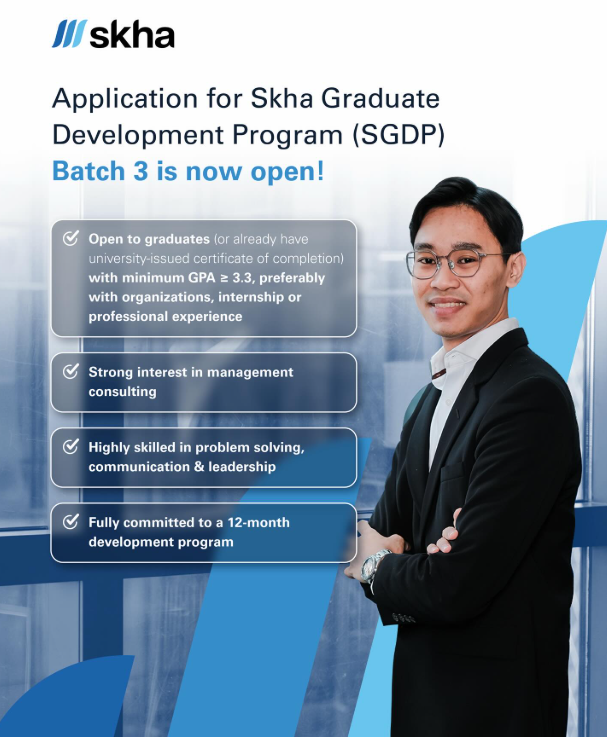
Understanding the eligibility requirements clearly is the first practical step toward a serious application. Here is what Skha specifies for SGDP Batch 3, along with honest commentary on what each requirement signals.
Educational qualification
The program is open to graduates or individuals who already hold a university-issued certificate of completion. The minimum academic requirement is a GPA of 3.30 or above.
The GPA requirement signals something specific: Skha is looking for people who demonstrated genuine academic engagement, not just passive participation in their degree. A 3.30 minimum is a meaningful bar. It filters for individuals who showed up consistently, worked seriously, and produced results at a level above the median of their academic cohort.
That said, GPA is a floor, not a ceiling, and it is certainly not the only thing that matters. The application and recruitment process looks at the whole picture. But if your GPA falls below 3.30, you will not be eligible for this batch, and that is worth knowing before you invest time in preparing an application.
If you are in your final semester and have not yet received your official diploma but do have a university-issued certificate of completion (a letter confirming your graduation, for example), you are still eligible. The requirement is not that you hold a diploma in hand; it is that your completion is formally verified.
Organizational, internship, or professional experience (preferred)
The requirements note that experience through organizations, internships, or professional roles is preferred. This does not mean that candidates without this experience are automatically disqualified, but it does mean that those who have it will be more competitive, and for good reason.
Management consulting work requires professional maturity. The ability to function effectively in a client-facing environment, to navigate organizational dynamics, to take direction and give it, to manage your time across competing demands, these are capacities that develop through actual professional experience, not simply academic study.
If you have been active in student organizations, particularly in leadership roles or in project management capacity, that experience is genuinely relevant. If you have completed internships, particularly in consulting, business analysis, finance, or strategy roles, that background will strengthen your application materially. If you have any form of professional work experience, even part-time, make sure you frame it in your application in terms of what you learned and contributed, not just what your title was.
If you are a fresh graduate with no organizational or professional experience at all, you can still apply, but be honest with yourself about the additional work you will need to do to demonstrate the qualities Skha is looking for through other aspects of your application.
Strong interest in management consulting
This requirement is listed straightforwardly, but it deserves more unpacking than it usually gets. There is a difference between thinking that management consulting sounds interesting and prestigious, and genuinely understanding what the work involves and actively wanting to do it.
Skha will be assessing the authenticity and depth of your interest in consulting throughout the recruitment process. Candidates who can speak specifically about what aspects of consulting appeal to them, who have thought seriously about the nature of the work and the skills it requires, who have done research into Skha and can articulate why this firm and this program fit their goals, will be markedly more compelling than candidates who simply say they are interested in business.
Spend real time before you apply thinking about why consulting, and why Skha. The answers you develop will not only strengthen your application; they will also help you confirm for yourself that this is genuinely what you want to pursue.
Highly skilled in problem solving, communication, and leadership
These three competencies form the core of the consulting professional profile, and they are assessed explicitly throughout SGDP’s recruitment process.
Problem solving in the consulting sense means more than being able to solve math problems or puzzles, though the Math Test in the recruitment process does assess logical thinking and numerical skills. It means the ability to approach complex, ambiguous situations systematically, to identify the right questions before jumping to answers, to structure information into frameworks that reveal insights, and to develop recommendations that are both analytically sound and practically actionable.
Communication in consulting is both written and verbal, and both matter enormously. The ability to write clearly and precisely, to structure a document so that its logic is immediately apparent, to present complex ideas to an audience without either oversimplifying or overwhelming them, these are skills that consultants use every single day. If you are someone who has been told you communicate well, think carefully about what specifically you do well. If communication is an area you know you need to develop, be honest about that and show how you have been working on it.
Leadership in the context of SGDP eligibility does not require that you have managed a large team or held a prestigious title. Leadership here means the capacity to take initiative, to drive things forward when direction is ambiguous, to influence others’ thinking and behavior through the quality of your contributions, and to take ownership of outcomes rather than deferring accountability to someone else. Early-career leadership looks different from senior leadership, and Skha knows that. They are looking for the underlying orientation, not the title.
Full commitment to a 12-month development program
This requirement is stated simply but deserves full attention. Twelve months is a significant commitment, and Skha is being explicit about it for good reason.
Some graduates apply to structured development programs with a foot halfway out the door, treating the program as a bridge until something they consider more attractive comes along. This approach is unfair to the organization investing in your development, unfair to your cohort members whose collective experience is affected by the quality of engagement from every participant, and, perhaps most importantly, unfair to yourself. You get out of SGDP what you put in, and genuine, wholehearted commitment is the precondition for genuine development.
Before you apply, do an honest self-assessment. Are you genuinely willing to commit 12 months to this program regardless of other opportunities that might arise during that time? If the answer is yes, your commitment will be apparent throughout the recruitment process and throughout the program itself.
How to Apply for the Skha Graduate Development Program: Application Step by Step
The application for SGDP Batch 3 is submitted through Skha’s official careers page. The application form itself collects structured information across several key areas, and each section deserves careful, thoughtful attention.
Here is a section-by-section breakdown of what the application covers and how to approach each component:
Data Information
This is the personal and contact information section. Fill it in accurately and completely. Make sure your contact details, particularly your email address and phone number, are current and functional, because shortlisted candidates are contacted for next steps, and missing that contact because of an outdated email address is a completely avoidable setback.
Education Background
This section documents your academic history. Include your most recent degree, your institution, your graduation year or expected graduation, and your GPA. Be accurate. Skha will verify credentials, and inconsistencies between what you report in the application and what your transcript shows create problems that are entirely avoidable.
If your GPA is at or just above the 3.30 minimum, do not try to round up or obscure the number. Present it accurately and let the rest of your application demonstrate your capabilities. Integrity in your application documentation matters in its own right, and it also sets the foundation for your professional reputation within the organization if you are offered a place.
If you have relevant academic honors, a Dean’s List recognition, a scholarship, or academic awards, include them here. These details add texture to your academic profile and signal qualities like sustained high performance and recognition by credible evaluators.
Professional Experience
This section is where you document your work history, including internships, part-time professional roles, and any full-time employment. For each experience, provide enough context for the reader to understand what the organization does, what your specific role involved, and what you contributed or achieved.
The framing of professional experience that resonates most in a consulting application is outcome-oriented rather than activity-oriented. Do not just list tasks you performed. Describe what you actually accomplished and what the impact of your contributions was. If you supported a project, what did the project achieve? If you conducted analysis, what did the analysis reveal and how was it used? If you managed a process, how did it improve under your management?
Candidates who can frame even modest professional experiences in terms of outcomes and impact demonstrate the results orientation that consulting demands. Candidates who describe their experiences purely in terms of tasks and responsibilities leave the reader guessing about whether anything actually happened as a result of their work.
If you have no formal professional experience, be honest about that rather than inflating student or volunteer activities into something they were not. You can still present organizational and extracurricular experience in this section while being transparent about its nature.
Achievement
This section invites you to highlight your most significant achievements, whether academic, professional, organizational, or personal. Use this space intentionally.
The most powerful achievements to include are those that demonstrate the qualities Skha is specifically looking for: problem-solving ability, communication effectiveness, leadership, and the capacity to deliver results under challenging conditions. An achievement that shows all three of these dimensions in a single story is more powerful than three separate achievements that each show only one.
Think about a time when you identified a problem that others had not recognized or addressed, took initiative to develop a solution, communicated that solution effectively to an audience that needed to act on it, and produced a measurable result. That is the structure of a compelling achievement narrative for a consulting application.
If your strongest achievements are academic, present them with context. A high GPA in a demanding program at a competitive institution is a meaningful achievement. Be specific about what made it demanding and what you did to sustain your performance, rather than simply listing the GPA number.
Organization Experience
This section is dedicated to organizational involvement: student organizations, community groups, professional associations, volunteer roles, and similar engagements. For many fresh graduates, this section is where the most differentiated story lives.
Strong organizational experience for a consulting applicant demonstrates leadership, project management, stakeholder coordination, and the ability to achieve results through collaboration with others rather than through individual effort alone. The consulting profession is fundamentally collaborative, and evidence that you can function effectively as a leader and contributor within groups is genuinely valuable.
For each organizational experience, describe your role, the nature and scope of the organization’s work, and most importantly, what you specifically contributed and what was achieved. Generic descriptions like “member of student council” are far less compelling than specific descriptions of projects you led, initiatives you drove, and outcomes your contributions produced.
If you held leadership positions, describe what your leadership actually involved. How many people did you coordinate? What was the scope of your responsibilities? What challenges did you navigate and how? What did the organization or team achieve during your tenure that it would not have achieved without your contribution?
Submission
Before you submit, review every section of the application carefully. Read it as if you were the person evaluating it on the other side. Is every section complete? Is the information accurate? Is the framing consistent across sections? Is the overall picture you are presenting one that demonstrates genuine fit with SGDP’s requirements and Skha’s profile?
Submit well before the deadline. Last-minute submissions create technical risk (systems get overloaded close to deadlines) and leave you no time to address anything you want to revise after reading the application one final time.
Skha Associate Trainee Program Recruitment Process
The SGDP Batch 3 recruitment process consists of five stages, each designed to assess different dimensions of candidate readiness and fit. Here is what you need to know about each stage and how to prepare.
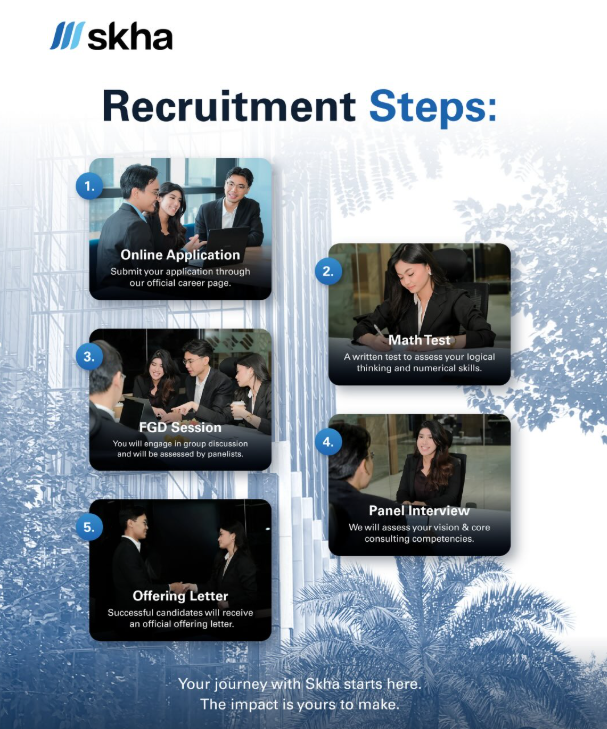
Stage 1: Online Application
The foundation is the application itself. Submit your complete application through Skha’s official careers page. The information you provide across the Data Information, Education Background, Professional Experience, Achievement, Organization Experience, and Submission sections forms the basis of the initial evaluation.
Shortlisted candidates will be invited to proceed to the next stages. Not every applicant will advance, and that is by design. The initial screening is looking for candidates whose profile genuinely meets the requirements: the GPA threshold, the demonstrated skills and experiences, the evidence of genuine interest in consulting, and the overall quality and care of the application presentation.
What this means for you: treat the application itself as your first professional deliverable for Skha. The quality of your application is the first data point the evaluation team has about how you approach important work. Apply that standard deliberately.
Stage 2: Math Test
The Math Test is a written assessment designed to evaluate your logical thinking and numerical skills.
This stage catches some candidates off guard because they assume that management consulting is primarily a qualitative discipline, heavy on strategy and communication and light on numbers. That assumption is wrong. Consulting is intensely quantitative in many respects. Financial modeling, data analysis, market sizing, operational efficiency measurement, cost-benefit analysis, these are regular features of consulting engagements, and the ability to think rigorously with numbers is non-negotiable.
The Math Test is not a calculus exam or a complex statistics assessment. It is evaluating the kind of numerical reasoning that underlies good analytical thinking: the ability to work with proportions, ratios, and percentages; to interpret data presented in tables and charts; to reason through logical sequences; and to perform accurate calculations under time pressure.
How to prepare: practice numerical reasoning and logical thinking problems in the weeks before the assessment. There are many free resources available for this kind of preparation. Focus not just on getting correct answers but on developing speed and accuracy simultaneously. Consulting work often involves working with quantitative analysis under time pressure, and the test is designed to simulate that environment.
Also, do not neglect the logical thinking dimension of the test. Logical reasoning problems, the kind that present you with a set of conditions and ask you to determine what must be true or false, assess the structured thinking capacity that is central to consulting methodology. Practice these deliberately as well.
Stage 3: FGD Session (Focus Group Discussion)
The FGD (Focus Group Discussion) session is where you engage with other candidates in a structured group discussion, assessed by a panel of evaluators.
This stage assesses qualities that are very difficult to evaluate from a written application alone: how you communicate in real time, how you engage with and build on others’ ideas, how you handle disagreement or conflicting perspectives, whether you drive conversations forward or simply respond to them, and how you balance assertiveness with collaborative openness.
The FGD is not a competition where you try to dominate the conversation. It is a collaborative exercise where your individual contribution is assessed in the context of the group dynamic you help create. The candidates who perform best in FGD sessions are those who engage substantively with the topic, build on and acknowledge others’ contributions, push for clarity when ideas are vague, and help the group move toward useful conclusions rather than circling indefinitely around abstractions.
How to prepare: practice structured communication, whether in conversations with friends, in study groups, or in organizational settings. Work on being able to organize your thoughts quickly before you speak, so that what you say is clear and purposeful rather than exploratory. Practice active listening so that you can genuinely engage with what others have said before adding your perspective.
Also, think about how you handle intellectual disagreement. In consulting, productive disagreement is how better answers get developed. Being able to push back on an idea you think is flawed while doing so respectfully and constructively, and being genuinely open to having your own view changed by a compelling counter-argument, is a hallmark of the kind of thinking that consulting values.
Stage 4: Panel Interview
The Panel Interview is a structured one-on-one or panel format assessment focused on your vision and core competencies. This is the stage where Skha evaluates who you are as a person and a professional, what drives you, how you think about your own development, and whether your values and orientation align with what Skha is building.
Expect questions that probe the depth and authenticity of your interest in consulting, the nature and quality of your past experiences, how you have handled challenges, failures, and complex situations, and what you are genuinely aspiring toward in your professional life.
The panel will also be assessing your competencies directly. Be ready for behavioral questions in the format: “Tell me about a time when you had to solve a complex problem with limited information. What did you do and what was the outcome?” These questions are designed to elicit specific examples rather than general claims, because specific examples are far more revealing about actual behavior and capability than general statements about what you would do hypothetically.
How to prepare: review your application before the interview and be ready to discuss every experience and achievement you mentioned in detail. Develop three to five strong, specific stories from your past experiences that demonstrate problem-solving, communication, leadership, and results orientation. Practice telling each story clearly and concisely, with enough detail to be credible and specific, but without becoming so detailed that you lose the listener.
Also prepare thoughtful answers to questions about your vision for your career and your understanding of management consulting as a profession. Why consulting? Why Skha? Where do you want to be in five years, and how does SGDP connect to that vision? These are questions you should be able to answer with genuine conviction, not rehearsed talking points.
Research Skha before the interview. Understand what the firm does, who its clients are, what kinds of projects it undertakes, and what it stands for as an organization. The quality of your research will be apparent in the depth and specificity of your answers, and it signals respect for the process and genuine interest in the opportunity.
Stage 5: Offering Letter
Successful candidates will receive an official offering letter as the final step of the recruitment process. This is the formal confirmation that Skha is extending you a place in SGDP Batch 3.
Review the offering letter carefully before signing. Understand the contract terms, the program start date, the compensation and benefit structure, and any conditions attached to the offer. If you have questions, ask them before signing rather than after.
Once you accept, treat that commitment seriously from day one. Your professional reputation at Skha begins the moment you sign the offering letter, not the moment you walk through the door on your first day.
Career Path from Associate Trainee to Full-Time Consultant
One of the most important things to understand about SGDP Batch 3 is that it is not a standalone program that ends when 12 months are up and everyone disperses. It is a structured entry point into a genuine career path at Skha.
The trajectory from Associate Trainee to full-time Consultant is a real and documented pathway within the firm. Let us trace what that journey actually looks like.
The Associate Trainee phase (months 1 through 12)
During the 12-month program, you are an Associate Trainee. That title carries specific meaning: you are in a development phase, building toward the standard of a full-time consulting professional. Your responsibilities are real and meaningful, but they are appropriately scoped for someone who is actively developing rather than fully formed.
Across this period, your performance is evaluated continuously, not just at the end. Your project contributions, your engagement with the training curriculum, your responsiveness to coaching and feedback, your growth across the core competencies, and your professional behavior all form the basis of the assessment that determines your transition.
The honest reality is that not every Associate Trainee who enters SGDP will transition to a full-time consultant role at Skha. The program is designed to develop the capability and character that consulting requires, and the transition to full-time is earned rather than given. But for Associate Trainees who genuinely engage with the development process, who take their project work seriously, who use the mentorship and coaching relationship actively, and who demonstrate the growth and competency that Skha is looking for, the pathway is clear and the opportunity is real.
The transition to full-time Consultant
At the conclusion of SGDP, Associate Trainees who have demonstrated the required competencies and professional qualities are offered a full-time Consultant position. This transition represents a meaningful shift in both status and responsibility. As a full-time Consultant, you carry the full weight of the role: managing client relationships, leading workstreams within engagements, mentoring junior colleagues, and contributing to the firm’s intellectual and commercial development.
For many SGDP graduates, the transition to full-time Consultant is the moment when everything the 12-month program built clicks into place. The skills you developed become the tools of your daily work. The professional identity you built during the program becomes your actual professional identity. The network you built within the firm becomes your core professional support system.
What comes after the Consultant level
Consulting career ladders vary across firms, but they typically progress from Analyst or Junior Consultant through Senior Consultant, Manager, and Principal levels, with some firms capping at Partner or Director. At each level, the nature of the work shifts: earlier levels focus more on analytical execution and project delivery, while later levels focus more on client relationship management, business development, and organizational leadership.
At Skha, the career progression beyond the Consultant level rewards exactly the qualities that SGDP develops: the ability to think rigorously and communicate clearly, the capacity to build trusted client relationships, the judgment to navigate complex and ambiguous situations effectively, and the leadership to develop and mentor the next generation of consultants.
The SGDP to Consultant pathway is not the ceiling of what Skha offers its people. It is the foundation.
Professional Training and Mentorship in Management Consulting
It is easy to list professional training and mentorship as program features. It is more useful to understand why these specific investments are so consequential for early-career consultants, and why Skha has structured SGDP around them.
The professional training imperative
Management consulting is a discipline that requires a specific set of technical and professional skills that are not comprehensively taught in any university curriculum. This is not a critique of universities; it simply reflects the fact that academic institutions are not primarily vocational training environments, and the specific craft skills of consulting practice require applied learning in professional settings.
The training curriculum in SGDP addresses this gap directly. When you learn to structure a problem using a consulting framework, you are not just learning a theoretical model. You are developing a cognitive habit, a way of approaching complex situations that you will use repeatedly across your career.
When you practice building a financial model or a data visualization, you are building a technical capability that you will deploy on actual client engagements. When you practice presenting your analysis to a senior consultant who gives you direct, substantive feedback, you are accelerating the development of communication skills that might otherwise take years to develop through solo trial and error.
The breadth of the training curriculum across SGDP is also important. Consulting engagements draw on knowledge from multiple disciplines simultaneously: finance, operations, strategy, organizational behavior, data analysis, industry dynamics, and stakeholder psychology. A consultant who is strong in one dimension but weak in others is less effective than one who has foundational competence across all of them. The training in SGDP is designed with that breadth in mind, giving Associate Trainees a comprehensive professional foundation rather than a narrow technical specialization.
There is also a compounding effect to professional training that is easy to underestimate. The frameworks, habits, and skills you develop in your first year of consulting do not sit static. They interact with your growing project experience, your expanding client exposure, and your deepening understanding of business dynamics to produce accelerating capability growth. The return on well-designed early-career training is not linear. It multiplies.
The mentorship advantage
Let us talk about mentorship with more precision than it usually receives, because the word gets used loosely in ways that obscure how it actually works and why it matters so much.
Effective mentorship in a professional context is not about inspiration or motivation, though it can produce both. It is about the transfer of experiential knowledge that cannot be learned from books, courses, or even solo project experience. It is about having someone who has already made the mistakes you are about to make tell you clearly what those mistakes look like and how to avoid them. It is about having someone who can read the organizational landscape of a client environment and help you understand what is really going on beneath the surface of what people are saying. It is about having someone who can give you an honest assessment of your strengths and developmental areas that is grounded in real observation of your actual performance, not generalized feedback that could apply to anyone.
At Skha, the mentors in SGDP are experienced consultants. They have done the work. They have navigated the challenges. They have developed their own capabilities through the same kind of demanding environment that SGDP creates. Their mentorship is therefore grounded in genuine shared experience rather than abstract advice from a distance.
The mentor-mentee relationship in SGDP is also structured rather than incidental. It is not a matter of hoping that a busy senior person occasionally finds time to talk with you. The mentorship relationship is a designed feature of the program with regular touchpoints, defined development objectives, and mutual accountability between mentor and mentee. That structure is what turns mentorship from a nice idea into a genuine development mechanism.
One often overlooked dimension of mentorship is the internal advocacy it creates. When a respected senior consultant knows your work deeply and has invested in your development, that relationship creates visibility within the organization that purely external reputation cannot replicate.
Your mentor becomes someone who can speak credibly to your capabilities in conversations that you are not part of but that materially affect your career trajectory. The professional visibility that flows from strong mentorship relationships is one of its least celebrated but most practically important benefits.
Real Consulting Project Experience for Graduates
There is a fundamental truth about developing professional competence that career advisors and academic institutions sometimes understate because it complicates the narrative they prefer: classroom learning and professional performance are different things, and the gap between them only closes through real work experience.
This is not a criticism of academic education. Understanding theoretical frameworks, developing analytical habits, building a broad knowledge base, these are genuine and valuable contributions of university education to professional preparation. But they are not sufficient on their own, and the consultants who develop fastest are almost universally those who get into real work environments early and stay in them consistently.
SGDP’s commitment to real consulting project exposure for Associate Trainees is therefore not just a program feature; it is the central mechanism through which the most important development happens.
What makes project experience irreplaceable
Real projects have real consequences. When you produce an analysis for an actual client engagement, the quality of your work affects the quality of the firm’s output and the client’s decision-making. That accountability pressure sharpens performance in ways that simulated exercises cannot fully replicate. You learn to be precise because imprecision has visible consequences. You learn to communicate clearly because unclear communication causes real problems. You learn to manage your time because deadlines on live projects are not flexible in the way that assignment submission windows sometimes are.
Real projects also expose you to the full complexity of consulting work in ways that simplified case studies cannot. In a real engagement, the data is messy and incomplete, the client’s stated problem is often not the actual problem, the stakeholder landscape involves competing interests and conflicting information, and the path from initial brief to final recommendation requires navigating uncertainty that no textbook fully prepares you for. Learning to function effectively in that environment is what becoming a consultant actually means, and it can only happen through genuine project immersion.
Real projects also teach you about yourself in ways that structured learning environments do not. How do you perform under genuine pressure? How do you respond when your analysis leads to a conclusion that contradicts what the client was hoping to hear? How do you maintain quality when multiple deadlines converge simultaneously? How do you recover when you make a mistake on work that actually matters? These are revealing questions, and the answers you develop through real project experience become foundational knowledge about your own capabilities and limitations.
The learning density of project work
Professional learning in consulting happens at an extraordinarily high density when the work is real. In a single engagement, you might encounter challenges that span financial modeling, stakeholder communication, organizational diagnosis, industry research, presentation design, and project management simultaneously. Each of those encounters generates learning that stacks onto previous experience and compounds with future experience to produce a rate of professional development that simply cannot be matched by any other means.
This is why management consulting is consistently identified as one of the highest-learning-rate environments in professional life, particularly in the early career years. And it is why SGDP’s commitment to genuine project exposure, rather than simulated or entirely protected training environments, is central to the program’s value proposition.
The portfolio you build
There is also a tangible career asset built through real project experience: a credible professional portfolio. Every engagement you contribute to during SGDP adds to a body of professional work that you can speak about with specificity and authority in future career conversations. The difference between saying “I completed a 12-month training program” and saying “I contributed to three client engagements across different industries, including an operational efficiency review that produced specific measurable outcomes” is the difference between describing a credential and demonstrating a capability.
At the end of 12 months, Associate Trainees who have engaged fully with SGDP’s project work component have a professional portfolio that most graduates of comparable age and experience cannot match.
Management Consulting Opportunities for Fresh Graduates
It is worth situating SGDP within the broader landscape of management consulting opportunities for fresh graduates in Indonesia and Southeast Asia more generally, because context helps you evaluate your options with appropriate perspective.
The graduate consulting landscape in Indonesia
Indonesia’s management consulting sector has grown substantially over the past decade, driven by rapid economic development, increasing complexity of business and government operations, and growing demand for evidence-based strategic advice. Both global consulting firms with Indonesia offices and local firms like Skha operate in this market, serving corporate clients, government agencies, development organizations, and state-owned enterprises.
For fresh graduates, entry pathways into this sector vary significantly across firms. Global consulting firms typically run highly competitive graduate recruitment programs with assessment processes that span several months and cohort sizes that are small relative to application volumes. The brand recognition of these firms is high, which means competition for their entry-level positions is correspondingly fierce.
Local consulting firms like Skha offer a different but equally valuable entry point. The work is substantive and real, the development investment in SGDP is genuine and structured, and the career growth potential for high performers is significant. Moreover, the experience of building a career within an Indonesian consulting firm that serves Indonesian clients develops a depth of local market knowledge, relationship capital, and contextual understanding that can be deeply valuable regardless of where a career subsequently goes.
What SGDP specifically offers that other programs do not
Most graduate employment programs across Indonesian companies offer some combination of job rotation, training, and mentorship in a structured format. SGDP differs in several important ways.
The domain specificity of SGDP is one of its most important features. This is not a general management trainee program where you rotate across HR, finance, marketing, and operations before landing somewhere. It is a focused development program built specifically around the craft of management consulting. If consulting is genuinely your goal, that focus is enormously more valuable than a generalist rotation that dilutes your development across multiple directions simultaneously.
The real client project exposure from early in the program is another differentiator. Many graduate programs keep trainees in protected learning environments for an extended period before exposing them to real work. SGDP integrates real project work into the development experience from the outset, which accelerates the practical learning curve substantially.
The mentorship model, with experienced consultants invested in your development through a structured relationship, provides a quality of professional guidance that many larger organizations simply cannot deliver because their senior people have too many other demands on their attention.
The longer-term career optionality
A point worth making explicitly: building your career foundation in management consulting creates optionality that few other starting points can match.
Consulting alumni are found throughout Indonesian business, government, and civil society in senior roles. Former consultants bring with them a set of analytical, communication, and problem-solving capabilities that have currency across virtually every professional context. The consulting credential is understood and valued by employers across sectors, which means that starting your career in consulting, whether you stay for three years or thirty, creates a professional platform from which many directions are open.
This optionality is not hypothetical. It is consistently documented in the career trajectories of people who started in consulting and then moved into industry, entrepreneurship, policy, or development roles. The skills developed in consulting transfer broadly, and the professional reputation built during consulting years carries weight in subsequent career chapters that is difficult to establish through other starting points.
Making the Most of Your 12 Months
If you receive an offering letter from Skha and join SGDP Batch 3, the question shifts from how to get in to how to get the most out of the experience. This section is for the person who is already thinking about that question, whether in advance or on day one of the program.
Approach it like a professional, not a student
This sounds obvious, but the transition from student mindset to professional mindset is genuinely one of the hardest shifts early-career professionals make. In academic environments, there are clear rubrics, known assessment criteria, and a culture of tolerance for incomplete understanding. In professional environments, the standards are implicit, the expectations are inferred as much as stated, and the tolerance for incompleteness is much lower because real work has real consequences.
From your first day in SGDP, approach the work as a professional. Take every deliverable seriously regardless of whether it feels important or visible. Meet every commitment, including informal ones. Be reliable in the most basic sense: do what you say you will do, when you said you would do it. These habits of professional reliability are noticed from the beginning and they shape the reputation you build within the firm faster than almost any other factor.
Use the mentorship relationship actively
Your mentor cannot develop you if you do not engage with the relationship. Come to every mentoring conversation with specific questions, specific challenges, and specific things you want to think through. Share the real issues you are encountering, not just the ones that are comfortable to discuss. Ask for honest feedback and genuinely receive it, which means thanking your mentor for difficult feedback and acting on it visibly rather than defensively explaining why the feedback does not apply.
The Associate Trainees who develop fastest in programs like SGDP are consistently those who use their mentorship relationship most actively and most honestly. The ones who hold back, who present only their successes and hide their struggles, who receive feedback politely but do not change their behavior, develop more slowly and miss much of the program’s potential value.
Treat every project as a learning opportunity, not just a deliverable obligation
It is tempting, particularly under time pressure, to treat project work as purely a delivery task: complete the required analysis, produce the required output, submit it by the deadline, and move on. That approach will get the work done, but it will not capture the learning that the work contains.
After every significant piece of project work, take time to reflect. What did you learn from this piece of analysis that you did not know before? What would you do differently if you were starting it again? What did the client’s reaction to the output tell you about how well you understood their actual needs? What did the feedback from your project team tell you about your current skill level and your developmental gaps?
Deliberate reflection turns project experience into genuine learning rather than mere repetition of tasks. This reflective habit is what separates consultants who plateau early from those who continue developing throughout their career.
Build relationships across the firm, not just within your immediate team
SGDP gives you access to the full Skha organization, not just the colleagues you work with most directly on a day-to-day basis. Use that access to build relationships across teams, practice areas, and seniority levels. Learn from people whose work is different from yours. Understand how different parts of the organization connect to each other. Contribute to firm-wide activities and discussions, not just to your immediate project team’s work.
The internal network you build during your 12 months in SGDP becomes the professional community within which your subsequent career at Skha unfolds. Investing in that network from the beginning pays returns throughout your career that cannot be replicated by focusing narrowly on your immediate deliverables.
Be honest about your developmental gaps
Every Associate Trainee in SGDP will have developmental gaps. That is not a weakness or a failure; it is the condition of being early in a demanding professional path. The question is not whether you have gaps but how you respond to them.
Associate Trainees who acknowledge their developmental gaps honestly, who ask for help and guidance when they encounter the limits of their current capabilities, and who actively work to close those gaps through focused effort and practice, develop faster and build stronger professional reputations than those who try to perform beyond their actual capability or who avoid situations where their gaps might be exposed.
Intellectual honesty about your own development is one of the qualities that experienced mentors and hiring managers most consistently identify as predictive of long-term professional success. It signals self-awareness, integrity, and the growth orientation that distinguishes people who continue developing throughout their career from those who plateau when the demands of the work exceed their current comfort zone.
FAQs
Throughout the process of researching and preparing for SGDP applications, certain questions come up repeatedly. Here are honest, direct answers to the most common ones.
Can I apply if I graduated more than a year ago?
The eligibility requirements specify that the program is open to graduates. There is no explicit cutoff on graduation year in the stated requirements, but the program is designed for individuals who are at the beginning of their professional careers rather than those who have several years of full-time professional experience under their belt. If you graduated two or three years ago and have significant professional experience, you might find that the Consultant-level recruitment track is actually a better fit for your profile than the Associate Trainee pathway. If you are uncertain, it is worth reaching out to Skha directly before investing heavily in an SGDP application.
What if my GPA is exactly 3.30?
The stated minimum is a GPA of 3.30 or above. A GPA of exactly 3.30 meets the minimum requirement. The rest of your application will carry significant weight in determining whether you advance through the recruitment process.
Is SGDP paid?
The program offers an Associate Trainee position, which is a professional role within Skha. Details about the specific compensation structure are best confirmed directly with Skha through the official careers page or during the recruitment process.
What happens if I am not selected for a full-time Consultant role at the end of SGDP?
Not every SGDP participant will transition to a full-time Consultant position at Skha. However, completing 12 months of structured management consulting development, gaining real project experience, and building a professional network within a reputable consulting firm creates a genuinely strong foundation for subsequent career moves. The SGDP experience, even without a direct transition to a full-time role at Skha, positions you well for consulting roles at other firms, strategy roles within corporations, or other professional positions that value analytical and communication capabilities.
What majors are most competitive for SGDP?
Management consulting draws on thinking skills and professional capabilities rather than specific domain knowledge, which means candidates from a wide range of academic backgrounds succeed in the profession. Business, economics, engineering, and quantitative social sciences are common backgrounds among successful consulting applicants, but strong candidates also come from law, political science, natural sciences, and humanities. What matters most is the quality of your thinking, the strength of your communication, and the evidence of your leadership and problem-solving capabilities, regardless of what you studied.
How competitive is the SGDP selection process?
Skha is a professionally serious firm that invests significantly in the development of its Associate Trainees, which means the selection process is genuinely competitive. Not every applicant is shortlisted, not every shortlisted candidate passes the Math Test, not every Math Test passer advances through the FGD and Panel Interview stages. The process is designed to identify candidates who genuinely meet the requirements rather than to fill a quota regardless of quality. Treat every stage with full seriousness, prepare thoroughly, and present yourself as authentically and specifically as possible.
Conclusion
Let us end where we began, with an honest conversation about fit.
SGDP Batch 3 is not the right program for everyone, and it is worth spending genuine time thinking about whether it is right for you specifically before you invest in the application process.
It is right for you if management consulting is genuinely what you want to do, not because it sounds impressive or because you are not sure what else to pursue, but because you understand what the work involves and you are genuinely drawn to it. It is right for you if you are prepared to commit fully to a demanding 12-month development program and to bring your whole professional self to that commitment. It is right for you if you value structured development, genuine mentorship, and real project experience as the foundations of a professional career in consulting.
It is probably not right for you if you are primarily motivated by prestige rather than genuine interest in the work. It is not right for you if you are planning to treat the program as a stopgap while you wait for something else. It is not right for you if you are not genuinely prepared for the demands of professional consulting work, including the precision, the accountability, and the continuous performance standard that the profession requires.
If after that honest self-assessment the answer is yes, this is the right direction, then the guidance in this article gives you a solid foundation for a competitive application. Prepare thoroughly for each stage of the recruitment process. Present yourself specifically and authentically. Demonstrate genuine knowledge of and commitment to Skha and to consulting as a profession. And bring to the application process the same qualities that you will need to bring to the work itself: rigorous thinking, clear communication, intellectual honesty, and genuine engagement with every challenge in front of you.
SGDP Batch 3 represents an extraordinary opportunity for the right candidate. The program is structured and proven. The mentorship is genuine. The project exposure is real. The pathway to a full-time consulting career is clear and documented. For a fresh graduate who is serious about building a career in management consulting, it is difficult to find a better starting point in the Indonesian market.
The application is open. The deadline is running. What you do with this opportunity starts right now.